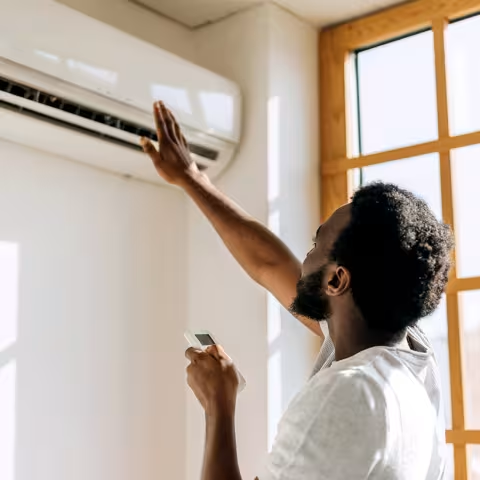
Dial in comfort and efficiency.
Choose the right mode.
Using the correct mode keeps your home comfortable. It also prevents the system from switching back and forth unnecessarily.
- Set your system to “Heat” in the winter and “Cool” in the summer.
- Avoid the compressor’s “Auto” mode unless temperatures swing throughout the day.
- Use the unit’s “Dry” mode only for dehumidifying on rainy or mild, humid days.
Set the fan to run on “Auto.”
Not the compressor — the fan. Doing so improves comfort and saves energy, as the system selects the most efficient speed for the moment.
- Select the “Auto” fan setting for your everyday use.
- Use the “Medium” or “High” fan speed when faster heating or cooling is needed. Be sure to then return the fan to “Auto” once the desired temperature has been reached.
- If your unit has a “Quiet” feature, use it when noise sensitivity matters.
Avoid frequent temperature changes.
Heat pumps are at their best when you avoid constant adjustments. A steady temperature will help your unit deliver efficient, consistent comfort and avoid slow recovery times.
- Choose a temperature setting that feels good to you, even if it differs from the setting you used on your old system’s thermostat.
- Set it and forget it. Leave the thermostat setting alone unless a change is truly necessary.
- If a change is necessary, raise or lower the temperature in small increments (1° to 3°) and increase the unit’s fan speed.
Know what’s normal.
Allow the defrost cycle to run.
Your heat pump’s defrosting function is essential for cold-weather performance and prevents ice buildup on the outdoor components.
- Expect brief pauses in airflow during cold weather, as the unit defrosts.
- Depending on your heat pump, you may see blinking lights, steam coming from the outside unit, or louder compressor sounds.
- Don’t interrupt your unit’s defrost cycle. It will finish on its own, with heat resuming automatically.
Expect to hear some new sounds.
While heat pumps are generally much quieter than traditional HVAC, the noises they do make are a bit different.
- Gentle fan noise, shifting compressor tones, clicks, and fluid movement are normal.
- Reach out to your contractor if sounds become unusually loud or considerably different from the established “normal.”
Know the troubleshooting basics.
Check your remote and thermostat first.
Before assuming a mechanical problem is to blame for your heat pump’s inactivity, consider that simple control issues can mimic equipment failure.
- When using a remote control, keep batteries fresh to ensure a strong signal.
- Allow 3 to 5 minutes for the system to respond to changes at the thermostat.
Match modes on multi-zone systems.
Multi-zone systems share the same compressor, so mismatched modes can cause your system to behave unpredictably.
- Set all units to the same mode — heat or cool.
- Avoid mixing heating, cooling, or even dehumidifying across zones.
Do your homework.
Read the equipment owner’s manual.
Understanding your specific heat pump model is especially valuable. The manual covers features, alerts, maintenance needs, FAQs — everything you need to know to keep the system running smoothly.
- Keep the manual handy for quick reference.
- Use it to confirm cleaning and service schedules.
Chat with a member of our team.
Questions? Need assistance? Power Ahead Colorado Energy Advisors are here to assist you. Reach out to us at 1-844-303-9333 or send a message.
Keep your equipment running smoothly.
Clean or replace filters regularly.
Clean filters keep airflow strong and help your equipment operate efficiently.
- Check your heat pump filters every 1 to 3 months.
- Clean or replace them based on dust levels, pet hair, and general household activity.
Keep the outdoor unit clear.
Unrestricted airflow is necessary to keep your heat pump performing at its best in all seasons and weather.
- Always remove snow from outdoor components, as it can quickly accumulate and block airflow.
- Keep the vicinity of the outdoor unit free of plants and any other debris that may obstruct airflow or even clog and damage the unit’s coils or moving parts.
- Avoid covering or otherwise altering the outdoor unit. While it can be tempting to make an aesthetic improvement, doing so can impede airflow or other functions.
Pay attention to warnings.
Modern heat pumps feature alerts to make you aware of any issues that may arise during routine use. Watch for lit icons or error codes and address causes early.
- Check your equipment manual when you see unfamiliar icons or codes.
- Reach out to your contractor if warnings persist.
Schedule maintenance.
While occasional DIY upkeep is acceptable for certain household appliances, heat pumps specifically benefit from routine maintenance by an experienced professional. Schedule regular service to keep your system functioning reliably and efficiently.
- Follow your equipment manufacturer’s recommendations for periodic cleaning.
- Schedule annual inspections of your heat pump’s indoor and outdoor components.
Stay comfortable during extreme weather.
Prepare your system for the Colorado cold.
Even today’s cold-climate heat pumps can benefit from a helping hand. Taking a few precautions will keep your system at its best when winter conditions are at their worst.
- Keep the outdoor unit free of snow and ice.
- Close doors to unused rooms to concentrate heating.
Use backup heat strategically.
In some cases, a home’s system may incorporate a secondary heat source to supplement its heat pump. This is commonly referred to as a dual-fuel system.
- Ensure that equipment is functional and safe before using it as a supplemental source.
- Confirm whether the additional equipment activates automatically or requires manual control.
- If the supplemental heat source has its own thermostat, keep its temperature set lower than that of the heat pump.